
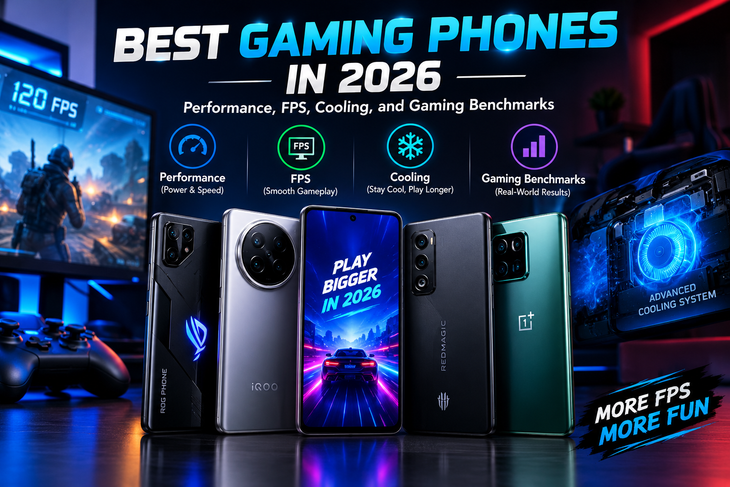
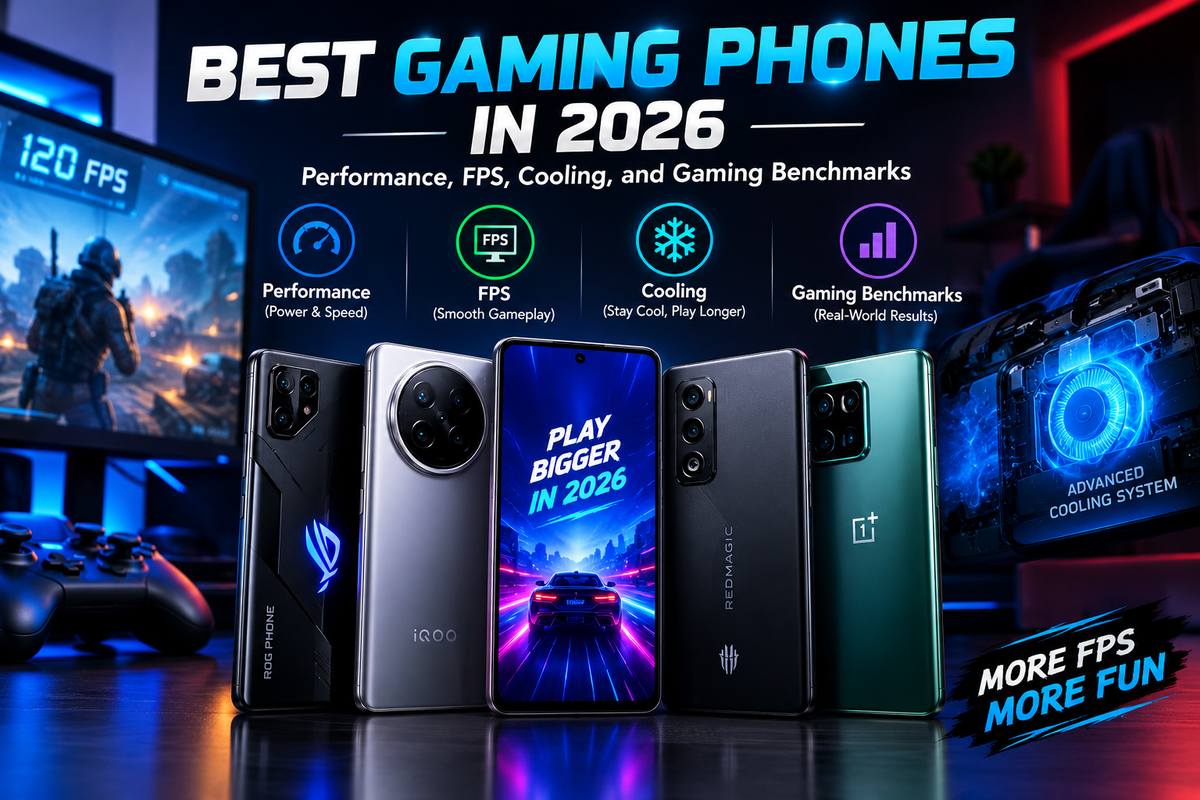
Mobile gaming has changed dramatically in recent years. Today’s smartphones are no longer limited to casual games. Flagship ors, high-refresh-rate displays, advanced cooling systems, large batteries, and gaming-focused software can deliver an experience that comes surprisingly close to dedicated handheld gaming devices.
In 2026, phones such as the REDMAGIC 11 Pro, REDMAGIC 11S Pro, ASUS ROG Phone 9 Pro, iPhone 17 Pro Max, Samsung Galaxy S26 Ultra, and OnePlus 15 are attracting gamers who want high frame rates and reliable performance.
But choosing a gaming phone is not simply about looking at the highest benchmark score. Sustained performance, temperature, FPS stability, touch response, battery life, and thermal management can make a much bigger difference during a long gaming session.
What Makes a Good Gaming Phone?
A powerful gaming phone needs several important components working together. The processor provides the raw performance, while the GPU handles graphics rendering. RAM helps with multitasking and keeping demanding games running smoothly.
A high-refresh-rate display is also important. Many gaming-focused smartphones now offer 144Hz panels, while some older gaming models have offered refresh rates even higher than that.
However, a high refresh rate does not automatically mean that a game will run at the same FPS. The actual frame rate depends on the game’s optimization, graphics settings, processor, GPU, thermal conditions, and software.
1. REDMAGIC 11 Pro
The REDMAGIC 11 Pro is designed specifically for gamers rather than simply being a conventional flagship with a powerful processor.
It uses Qualcomm’s Snapdragon 8 Elite Gen 5 processor and can be configured with up to 24GB of LPDDR5T RAM and 1TB of UFS 4.1 Pro storage. Its 6.85-inch AMOLED display supports up to a 144Hz refresh rate and offers extremely high touch-sampling capabilities for responsive controls.
The biggest feature is its cooling system. REDMAGIC combines a large vapor chamber, liquid cooling, liquid metal, thermal materials, and a 24,000 RPM fan.
Independent testing found that the phone maintained performance particularly well during sustained workloads. Notebookcheck recorded a Geekbench 6.7 single-core score of 3,741 points and described its gaming performance as top-tier, although surface temperatures can become high during demanding workloads.
REDMAGIC itself reports a 60.9 FPS average in a two-hour Genshin Impact comparison test, with considerably lower frame-rate variance than the comparison device. Because this is manufacturer testing, those figures should be treated as claimed results rather than independent benchmark measurements.
2. REDMAGIC 11S Pro
The REDMAGIC 11S Pro is aimed at gamers who want maximum sustained performance. Its main advantage is active cooling, which can help reduce thermal throttling during long gaming sessions.
A gaming phone can produce excellent benchmark numbers during a short test but lose performance as temperatures rise. Active cooling addresses this problem by continuously moving heat away from the processor.
The 11S Pro retains features such as a high-refresh-rate AMOLED display, large battery, gaming triggers, and dedicated gaming controls. Current 2026 reviews highlight its ability to sustain performance after conventional flagship smartphones begin reducing power under heavy workloads.
3. ASUS ROG Phone 9 Pro
ASUS has established the ROG Phone series as one of the most recognizable gaming-phone families.
The ROG Phone 9 Pro uses the Snapdragon 8 Elite chipset and features a gaming-focused design with advanced controls. Its display can reach up to a 185Hz refresh rate, while the phone’s AirTrigger controls provide additional inputs for supported games.
These shoulder-style controls can be particularly useful in first-person shooters because players can assign actions such as aiming, shooting, jumping, or crouching to physical touch-sensitive areas.
The ROG Phone 9 Pro also supports gaming accessories that can improve cooling and controls. Current 2026 buying guides continue to include it among the major gaming-phone options.
4. iPhone 17 Pro Max
Gaming is not limited to Android phones. Apple’s iPhone 17 Pro Max is also a strong option for mobile gamers because of its A19 Pro processor and access to a large library of optimized games.
Unlike dedicated gaming phones, the iPhone focuses on being an all-purpose flagship. It does not provide the same collection of gaming-specific features as REDMAGIC or ROG phones, but its processor performance and software optimization make it capable of running demanding games.
The iPhone 17 Pro Max is also highlighted by current gaming-phone guides as one of the strongest options for players who want gaming performance together with a premium everyday smartphone experience.
5. Samsung Galaxy S26 Ultra
The Samsung Galaxy S26 Ultra is another example of a mainstream flagship that can double as a gaming phone.
Instead of focusing exclusively on gaming, Samsung combines high-end performance with a large display, premium cameras, productivity features, and a sophisticated software ecosystem.
This makes it particularly interesting for people who want one phone for gaming, photography, work, entertainment, and everyday use.
Current 2026 gaming-phone guides identify the Galaxy S26 Ultra as a mainstream flagship capable of handling demanding games while offering much stronger camera capabilities than most dedicated gaming smartphones.
Why Cooling Matters for Gaming
Cooling is one of the most overlooked aspects of smartphone gaming.
When a processor becomes too hot, the phone can automatically reduce its performance. This process is known as thermal throttling. It protects the hardware but can cause FPS drops during long gaming sessions.
For example, a phone might initially deliver extremely high frame rates, but after 20–30 minutes of intensive gameplay, heat buildup could force the processor to reduce its clock speeds.
Dedicated gaming phones address this problem using technologies such as vapor chambers, graphite, liquid metal, thermal gels, and physical fans.
The REDMAGIC 11 Pro takes this approach particularly far with its liquid-cooling system and 24,000 RPM fan. However, independent testing also shows that powerful gaming hardware can still become hot and that the fan can be loud.
FPS: More Is Not Always Better
Frames per second, or FPS, measures how many frames a game displays every second.
A higher FPS can make movement appear smoother, particularly in competitive games such as PUBG Mobile, Call of Duty: Mobile, and other fast-paced titles.
However, stable FPS is often more important than peak FPS.
For example, a phone maintaining 60 FPS consistently can provide a better experience than one that jumps between 90 FPS and 40 FPS.
This is why gaming benchmarks should include long stress tests rather than only short performance tests.
Understanding Gaming Benchmarks
Several benchmark tools are useful when comparing gaming smartphones.
Geekbench measures CPU performance and provides single-core and multi-core scores.
3DMark focuses heavily on graphics performance and includes stress tests that can reveal how well a phone maintains performance over time.
AnTuTu combines CPU, GPU, memory, and user-experience measurements into an overall score.
However, benchmark scores should not be treated as a direct prediction of FPS in every game. Game engines, graphics settings, optimization, and software updates can significantly change real-world performance.
For gaming, it is better to look at benchmark scores together with sustained-performance tests and actual gameplay results.
Battery Life and Charging
Long gaming sessions consume considerable power. A powerful processor, bright high-refresh-rate display, and active cooling system can all increase battery consumption.
This is why gaming phones increasingly use large batteries. The REDMAGIC 11 Pro, for example, has a 7,500mAh battery, while also supporting fast charging.
Fast charging is useful when gamers need to return to a game quickly, but battery protection features are also important. Some gaming phones support charge-separation or bypass-charging technologies that can reduce the amount of heat generated while playing when connected to a charger.
Which Gaming Phone Should You Choose?
The right gaming phone depends on what you value most.
If your priority is sustained gaming performance and dedicated gaming hardware, phones such as the REDMAGIC 11 Pro and 11S Pro are designed specifically around that goal.
If you want gaming plus a traditional flagship experience, devices such as the iPhone 17 Pro Max, Samsung Galaxy S26 Ultra, and OnePlus 15 may be more suitable.
If you want physical gaming controls and gaming accessories, the ROG Phone family remains an important option.
Ultimately, don’t choose a gaming phone based solely on its highest benchmark score. Look at sustained FPS, cooling performance, display refresh rate, touch response, battery capacity, charging speed, software support, and the games you actually play.
Final Thoughts
The best gaming phones in 2026 demonstrate how far smartphone performance has progressed. Modern flagship processors can deliver exceptional graphics performance, while advanced cooling systems help maintain performance during demanding gaming sessions.
For serious gamers, the most important combination is high and stable FPS + efficient cooling + responsive controls + strong battery life.
A benchmark score tells you how powerful a phone can be at its peak. A long gaming session tells you how well that performance can actually be maintained.
Before buying, check independent gaming tests for the specific games you play. That will give you a much more realistic idea of what to expect than a single benchmark number.