
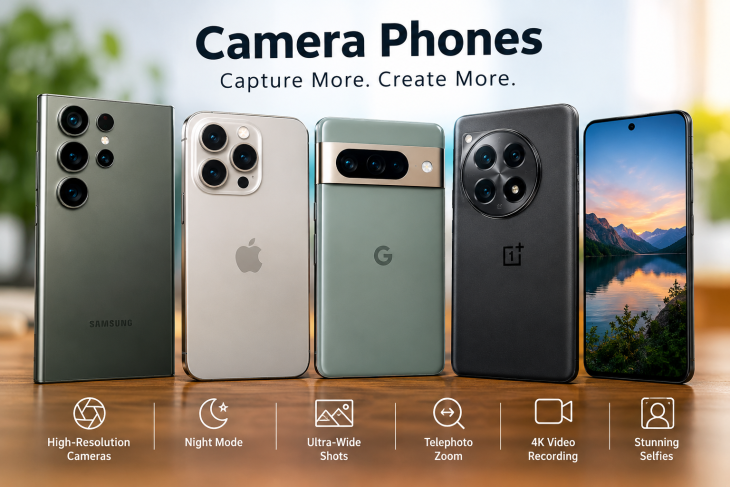
Smartphone cameras have improved dramatically over the last few years. A modern smartphone can capture detailed photographs, record high-resolution video, create professional-looking portraits, and produce impressive results in challenging lighting conditions.
For many people, the camera has become one of the most important factors when buying a new phone. Whether you enjoy travel photography, take pictures for social media, create YouTube videos, or simply want better family photos, choosing the right camera phone can make a significant difference.
However, finding the best camera phone isn’t as simple as choosing the device with the highest megapixel count. Camera quality depends on several factors, including the sensor, lenses, image stabilization, auto focus, image-processing software, and video capabilities.
In this guide, we’ll explain everything you should know before buying a camera-focused smartphone.
What Is a Camera Phone?
A camera phone is a smartphone that places a strong emphasis on photography and video capabilities.
Most modern smartphones have multiple cameras, with each camera designed for a different purpose. A typical multi-camera smartphone may include a primary wide camera, an ultra-wide camera, a telephoto camera, and sometimes a dedicated macro or depth sensor.
These cameras allow users to photograph different subjects without carrying additional equipment.
For example, the primary camera can be used for everyday photographs, while an ultra-wide camera can capture landscapes and a telephoto camera can photograph distant subjects.
Why Are Smartphone Cameras So Important?
People take billions of photographs using smartphones because they are convenient and always available.
Unlike a traditional camera, your smartphone is normally already in your pocket. You can quickly take a photograph, edit it, and share it online within seconds.
Smartphones are also becoming increasingly useful for content creation. You can use one device to:
- Take photographs
- Record YouTube videos
- Create Instagram Reels
- Record TikTok videos
- Capture travel footage
- Scan documents
- Take product photographs
- Record interviews
- Live stream content
This makes camera quality an important consideration when choosing a smartphone.
What Makes the Best Camera Phone?
There isn’t a single specification that determines whether a smartphone has a good camera.
Instead, camera performance comes from a combination of hardware and software.
1. Primary Camera Sensor
The primary camera is usually the most important camera on a smartphone.
It is responsible for most everyday photographs and generally receives the best camera hardware.
The sensor captures light and converts it into information that the phone uses to create an image.
A larger sensor can generally capture more light, which can help produce better results in difficult lighting conditions.
When comparing smartphones, don’t look only at megapixels. Sensor size and sensor quality can be equally or more important.
2. Megapixels
Megapixels describe the amount of image information a camera can capture.
For example, a 50MP camera has a sensor capable of capturing approximately 50 million pixels.
Higher resolution can be useful when cropping photographs or printing large images. However, a higher megapixel count does not automatically produce better photographs.
Image quality also depends on:
- Sensor size
- Lens quality
- Pixel size
- Image processing
- Dynamic range
- Auto focus
- Stabilization
This is why a well-designed 50MP camera can outperform a poorly optimized 108MP or 200MP camera.
3. Optical Image Stabilization
Optical Image Stabilization, or OIS, is another important camera feature.
Small movements of your hands can cause photographs to become blurry, particularly when taking pictures in low light.
OIS uses physical movement within the camera module to compensate for some of this motion.
OIS can be particularly helpful when:
- Taking night photographs
- Shooting indoors
- Photographing while moving around in low light
- Using Zoom
- Recording handheld video
If photography is important to you, OIS is a feature worth looking for.
4. Electronic Image Stabilization
Some smartphones also use electronic image stabilization, or EIS.
Instead of physically moving the camera sensor or lens, EIS uses software to compensate for movement.
Modern smartphones often combine OIS and EIS to produce smoother video.
This can be particularly useful for people who record walking videos, travel footage, or social media content.
5. Telephoto Camera
A telephoto camera is designed for photographing distant subjects.
For example, imagine you’re standing far away from a building or photographing a performer at a concert. A telephoto lens can bring the subject closer without relying entirely on digital cropping.
Telephoto cameras can also be useful for portraits because they can provide a more natural perspective.
If zoom photography is important to you, check the phone’s optical zoom capability rather than focusing only on its maximum digital zoom number.
6. Ultra-Wide Camera
Ultra-wide cameras capture a much wider field of view than the primary camera.
They are especially useful for:
- Landscapes
- Architecture
- Large buildings
- Group photographs
- Travel photography
- Interior photography
For example, if you’re standing close to a large building and can’t move farther away, an ultra-wide camera can help you fit more of the building into the frame.
However, ultra-wide cameras vary significantly in quality. Some provide excellent detail and color, while cheaper sensors may produce softer images.
7. Macro Camera
Macro cameras are designed for close-up photography.
They can be useful for photographing small objects such as:
- Flowers
- Insects
- Jewelry
- Textures
- Small products
However, a dedicated macro camera isn’t always necessary. Some smartphones use their ultra-wide cameras for close focusing instead.
When buying a phone, don’t assume that having a dedicated macro sensor automatically means better photography.
8. Auto focus
Fast and accurate autofocus is essential for photography.
A good autofocus system helps the camera quickly lock onto your subject.
This becomes particularly important when photographing:
- Children
- Pets
- Sports
- Cars
- Wildlife
- Moving people
A camera with excellent autofocus can capture moments that might otherwise be missed.
9. HDR Photography
HDR stands for High Dynamic Range.
HDR helps the camera capture detail in both bright and dark areas of an image.
For example, imagine photographing a person standing in front of a bright window. Without good HDR processing, the window may appear completely white while the person’s face is too dark.
HDR can help balance these areas.
Modern smartphones often use computational photography to combine multiple exposures and create an image with improved dynamic range.
10. Computational Photography
Computational photography is one of the biggest reasons smartphone cameras have become so powerful.
The phone’s processor and camera software analyze the image and make adjustments automatically.
Software can improve:
- Exposure
- Colors
- Sharpness
- Noise
- Dynamic range
- Skin tones
- Shadows
- Highlights
- Portrait effects
This means camera performance isn’t determined entirely by hardware.
Two smartphones with similar sensors can produce very different photographs because their software processing is different.
Best Camera Phones for Daylight Photography
Daylight is generally the easiest environment for smartphone photography because there is plenty of available light.
However, a good camera should still produce:
- Accurate colors
- Good skin tones
- High detail
- Balanced exposure
- Natural-looking HDR
- Fast auto focus
When comparing phones, don’t simply look for the brightest image.
Some smartphones increase brightness and saturation significantly, while others aim for a more natural appearance.
The preferred look is subjective, so checking real-world sample photographs is useful.
Best Camera Phones for Night Photography
Night photography is much more challenging.
When there is less light, the camera needs to capture more light while keeping noise under control.
This is where features such as large sensors, wide apertures, OIS, and advanced image processing become important.
A good night-mode system may take several photographs at different exposures and combine them into a single image.
When choosing a phone for night photography, consider:
- Sensor size
- OIS
- Aperture
- Night mode
- Auto focus
- Noise reduction
- Image-processing quality
Best Camera Phones for Portrait Photography
Portrait photography attempts to separate the subject from the background.
Smartphones use cameras, depth information, and software algorithms to create background blur.
A good portrait mode should produce natural-looking separation around:
- Hair
- Glasses
- Clothing
- Hands
- Face
- Shoulders
A poor portrait system may create unnatural edges or blur parts of the subject.
Telephoto cameras can also be useful for portraits because they allow you to photograph your subject from farther away.
Best Camera Phones for Video
Photography isn’t the only important camera feature.
For YouTubers, vloggers, influencers, and social media creators, video performance can be even more important.
Before buying a smartphone for video, look for:
4K Video
4K recording provides considerably more resolution than Full HD and gives creators more flexibility when editing.
Video Stabilization
Stabilization helps reduce unwanted camera movement.
Auto focus
Fast auto focus is important when the subject moves toward or away from the camera.
HDR Video
HDR video can improve detail in bright and dark areas.
Microphone Quality
Good video requires good audio. A smartphone with excellent image quality but poor microphone performance may not be ideal for content creation.
Best Camera Phones for Selfies
The front camera is important for people who frequently take selfies or record themselves.
A good selfie camera should provide:
- Natural skin tones
- Good dynamic range
- Accurate exposure
- Sharp facial detail
- Good portrait mode
- Strong low-light performance
- High-quality video
Auto focus on the front camera can also be useful because it can help keep the subject sharp at different distances.
Best Camera Phones for Social Media
Social media creators need more than just good photographs.
A good social-media smartphone should offer excellent front and rear cameras, strong video stabilization, fast processing, good microphones, and sufficient storage.
Battery life is also important because recording and editing video can consume significant power.
If you’re creating a lot of content, consider a phone with larger storage capacity rather than relying entirely on cloud storage.
Camera Phone vs DSLR or Mirrorless Camera
Smartphone cameras are incredibly capable, but dedicated cameras still have important advantages.
Smartphone Advantages
- Compact and lightweight
- Easy to carry
- Quick sharing
- Automatic image processing
- Multiple built-in focal lengths
- Easy editing
- Excellent computational photography
Dedicated Camera Advantages
- Larger sensors
- Interchangeable lenses
- Greater manual control
- Better lens selection
- Greater depth-of-field control
- More accessories
- More flexibility for professional workflows
For casual photography and social media, a smartphone can be extremely convenient.
For professional photography, dedicated cameras can still provide advantages that smartphones cannot fully reproduce.
Does a Higher Megapixel Camera Mean Better Photos?
No.
Megapixels are only one part of the equation.
Imagine two cameras:
Camera A: 200MP sensor with poor image processing.
Camera B: 50MP sensor with excellent optics, OIS, a larger sensor, and advanced processing.
Camera B can potentially produce better photographs despite having fewer megapixels.
This is why you should evaluate the entire camera system rather than one specification.
How Much Storage Do You Need for Photography?
Storage is often overlooked when buying a camera phone.
High-resolution photographs and especially 4K videos can consume significant storage.
If you regularly record videos, consider choosing a smartphone with at least enough internal storage for your typical usage and checking whether the phone supports expandable storage.
For serious content creators, larger internal storage can be especially useful.
How Important Is Battery Life?
Photography and video recording can consume considerable battery power.
The camera, display, processor, image processing, and storage all work together when recording high-resolution video.
If you travel frequently or spend a lot of time taking photographs, a phone with strong battery life can be more practical.
Fast charging can also be useful when you need to quickly recharge between shooting sessions.
How to Choose the Best Camera Phone for Your Needs
Different users need different camera features.
For Everyday Photography
Prioritize the primary camera, auto focus, HDR, and image processing.
For Travel Photography
Look for a versatile camera system with primary, ultra-wide, and telephoto cameras.
For Night Photography
Look for a larger sensor, OIS, good night mode, and strong image processing.
For Portraits
Consider a good telephoto camera and accurate portrait processing.
For YouTube
Prioritize video stabilization, 4K recording, auto focus, microphones, battery life, and storage.
For Social Media
Look for strong front and rear cameras, good video quality, fast performance, and easy editing features.
For Wildlife and Sports
A capable telephoto camera and fast auto focus are particularly important.
Common Mistakes When Buying a Camera Phone
Buying Only Because of Megapixels
Don’t assume that a 200MP camera automatically beats a 50MP camera.
Ignoring Video
If you create content, photography isn’t enough. Check video quality as well.
Ignoring Storage
Large video files can fill your storage quickly.
Buying Too Many Cameras
More cameras don’t necessarily mean better photography. Camera quality matters more than camera quantity.
Ignoring Software
Camera processing can dramatically affect the final image.
Not Checking Real-World Photos
Specifications don’t tell the entire story. Before buying, look at real photographs and videos captured with the phone.
Final Thoughts
Finding the best camera phone requires looking beyond megapixels.
A smartphone’s camera performance depends on the sensor, lens quality, OIS, auto focus, computational photography, image processing, and video capabilities.
If you mainly take everyday photographs, a strong primary camera may be enough. If you travel frequently, an ultra-wide and telephoto camera can provide greater flexibility. For content creators, video stabilization, microphones, auto focus, storage, and battery life become particularly important.
The most important thing is to identify what type of photography or video you actually do. Once you understand your requirements, you can choose a smartphone that provides the features you will genuinely use instead of paying for specifications that don’t matter to you.
Before making a purchase, compare real-world photographs, video samples, camera features, battery life, storage, and software support. This will give you a much clearer picture of the phone’s actual camera performance.
Frequently Asked Questions About Camera Phones
Which smartphone has the best camera?
There is no single smartphone that is best for every type of photography. Some devices focus on photography, while others may have particular strengths in zoom, portraits, night photography, or video.
Is 108MP better than 50MP?
Not necessarily. Camera quality depends on much more than megapixels. Sensor size, optics, stabilization, auto focus, and image processing all influence the final result.
What is the most important camera feature?
For many users, the primary camera sensor and image processing are among the most important factors. However, the ideal feature set depends on how you use your phone.
Is OIS necessary?
OIS isn’t absolutely necessary, but it can be very useful. It helps reduce camera shake and can improve results when photographing in low light or recording handheld video.
Is a telephoto camera useful?
Yes. A telephoto camera can provide better-quality zoom and can also be useful for portrait photography.
Are smartphone cameras good enough for YouTube?
Many modern smartphones are capable of recording high-quality video suitable for YouTube and social media. However, creators should also consider microphones, stabilization, lighting, storage, and editing capabilities.
Should I buy a phone with more cameras?
Not necessarily. The quality of the cameras matters more than the number of cameras. A smartphone with two or three excellent cameras can be more useful than one with several low-quality sensors.
What should I check before buying a camera phone?
Check the primary sensor, OIS, telephoto and ultra-wide cameras, auto focus, video resolution, stabilization, low-light performance, selfie camera, storage, battery life, and software support.
Can a smartphone replace a DSLR?
For everyday photography, travel, social media, and many content-creation tasks, a high-end smartphone can be an excellent alternative. Dedicated cameras still provide advantages such as larger sensors, interchangeable lenses, and greater manual control.
What is computational photography?
Computational photography uses software, artificial intelligence, and the phone’s processor to improve photographs. It can help with HDR, night photography, portrait effects, noise reduction, color processing, and other aspects of image quality.
This version is suitable as a long-form pillar article for your phone blog. You can also add a “Top 10 Best Camera Phones” section with current phone models, prices, specifications, and camera comparisons to make the article more useful for search traffic.