
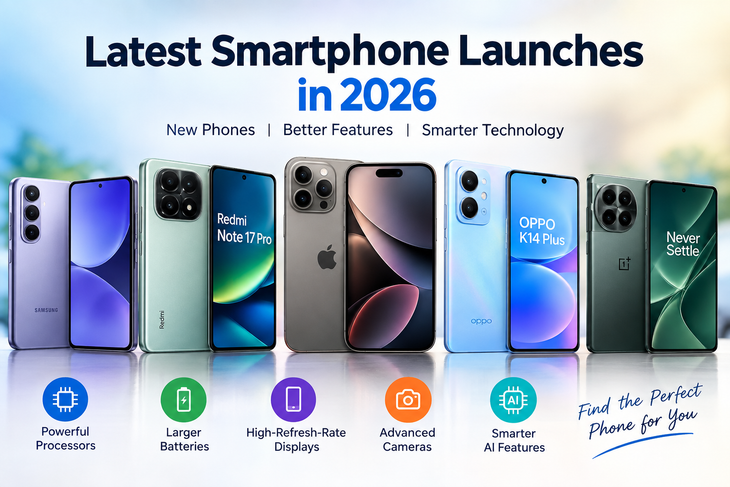
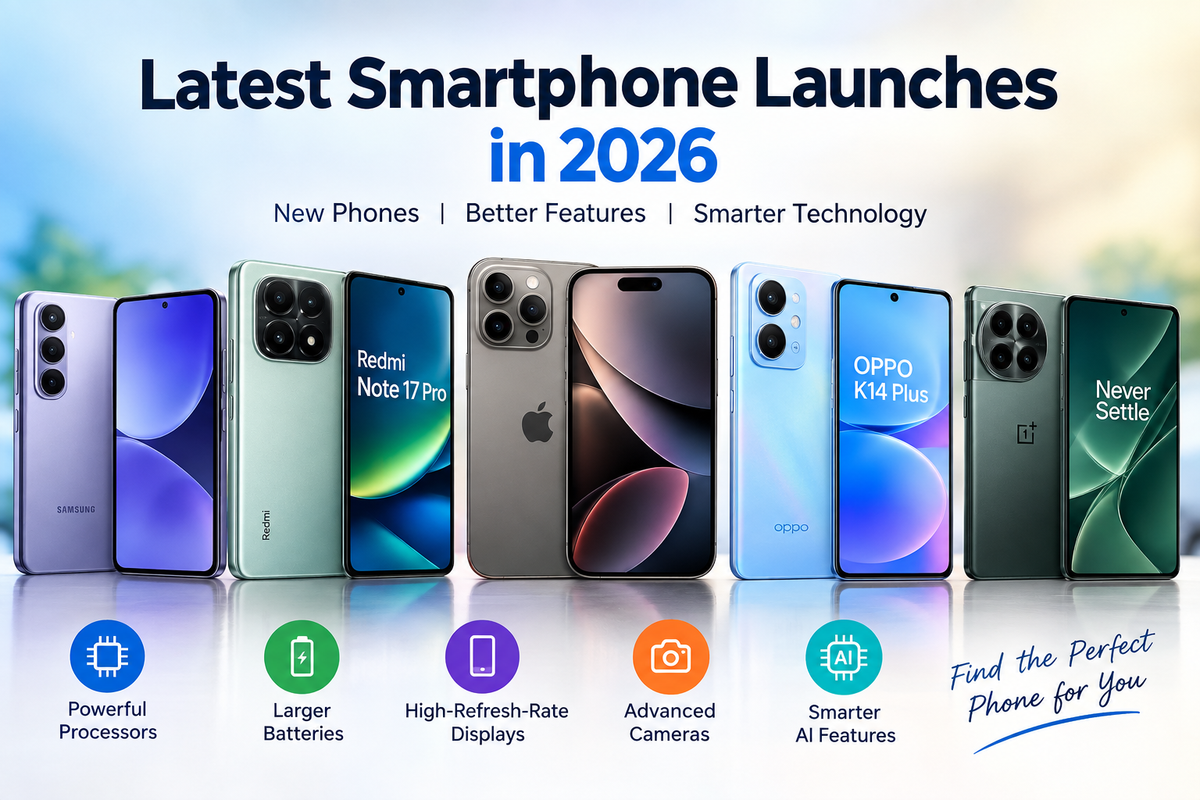
The smartphone market has become more competitive than ever in 2026. Manufacturers are introducing phones with larger batteries, faster processors, high-refresh-rate displays, improved cameras, and smarter AI features. September and October have been particularly active, with new devices arriving across budget, mid-range, and premium categories.
For Indian smartphone buyers, the latest launches include the Redmi 17C 5G, HMD Vibe 2 Pro 5G, OPPO K14 Plus, Redmi Note 17 Pro series, Samsung Galaxy F08 and M08, along with premium and upcoming devices from Apple, vivo, OPPO, OnePlus and other brands. (Beebom Gadgets)
Here is a closer look at some of the latest smartphone launches and the trends shaping the market.
Redmi 17C 5G
The Redmi 17C 5G is one of the newest smartphones launched in India. Xiaomi launched the device on October 1, 2026, with a starting price of ₹20,999 for the 4GB RAM and 128GB storage version. (Smartprix)
The phone features a large 6.9-inch HD+ display with a 120Hz refresh rate, making scrolling and animations smoother. It is powered by the MediaTek Dimensity 6300 processor and comes with a 50MP rear camera.
One of its major highlights is the 6,000mAh battery, supported by 33W fast charging. The phone also runs HyperOS 3 based on Android 16 and includes features such as Circle to Search.
HMD Vibe 2 Pro 5G
HMD has also entered the latest smartphone competition with the Vibe 2 Pro 5G, launched in India on September 29.
The phone combines a 6.78-inch Full HD+ display with a 120Hz refresh rate and a MediaTek Dimensity 6300 processor. It includes a 64MP primary rear camera and a 13MP front camera.
The 6,000mAh battery and 33W charging are designed for users who want longer battery life without moving into the premium price segment. The device is listed at ₹15,999 in India. (Beebom Gadgets)
OPPO K14 Plus
Another interesting recent launch is the OPPO K14 Plus. It brings several specifications that are normally associated with more expensive smartphones.
The phone features a 6.78-inch 1.5K AMOLED display with a 144Hz refresh rate. Under the hood, it uses the MediaTek Dimensity 7360 Max processor.
The biggest highlight is its enormous 8,000mAh battery, paired with 45W charging. It also has a 50MP primary camera and a 16MP selfie camera. The device is listed at ₹29,999 in India. (Beebom Gadgets)
Redmi Note 17 Pro Series
The Redmi Note series continues to target consumers looking for high specifications at comparatively accessible prices.
The Redmi Note 17 Pro comes with a 6.83-inch 1.5K AMOLED display and 120Hz refresh rate. It features a 50MP primary camera, 16MP front camera and a 9,000mAh battery with 67W charging.
The higher-end Redmi Note 17 Pro Max goes even further, offering a 10,000mAh battery and 100W charging, along with 8GB RAM and 256GB storage. (Beebom Gadgets)
These specifications show how battery capacity has become an increasingly important selling point in the smartphone market.
Samsung Galaxy F08 and Galaxy M08
Samsung has also introduced new affordable smartphones in India. The Galaxy F08 and Galaxy M08 launched on October 1, 2026.
Both phones feature a 6.72-inch display with a 90Hz refresh rate, a MediaTek Helio G99 Plus processor, a 50MP main camera and a 6,000mAh battery. Both are listed at ₹16,999 in the current Indian listings. (Beebom Gadgets)
These phones are aimed at users who want a familiar Samsung experience while staying within a more affordable price range.
Apple iPhone Duo
Apple’s 2026 smartphone lineup has also attracted considerable attention. The iPhone Duo is listed as a newly launched foldable-style device with a 7.6-inch 1.5K OLED display and 120Hz refresh rate.
According to current listings, it uses Apple’s A20 Pro processor and features a dual 48MP rear-camera setup. Its listed price is ₹2,99,900, making it a premium device aimed at consumers interested in Apple’s latest hardware direction. (Beebom Gadgets)
The arrival of new foldable devices also shows that manufacturers continue to experiment with alternative smartphone designs beyond conventional slab phones.
Huawei Mate 90 Series
Huawei recently launched its Mate 90 series, bringing another major flagship family to the smartphone market.
The series uses Huawei’s HarmonyOS 7 and the company’s Kirin 9050 Pro processor. Reuters reports that Huawei has developed the processor architecture as part of its effort to work around restrictions affecting access to advanced semiconductor technology. (Reuters)
The launch demonstrates that smartphone competition is increasingly extending beyond cameras and displays to include operating systems and chip design.
What Is Changing in Smartphones in 2026?
One of the clearest trends among recent launches is larger batteries. Devices such as the Redmi Note 17 Pro Max and OPPO K14 Plus show manufacturers pushing battery capacities to 8,000mAh, 9,000mAh and even 10,000mAh.
Another major trend is high-refresh-rate displays. 120Hz has become increasingly common, while some mid-range models now offer 144Hz displays.
AI features are also becoming more common. Smartphone manufacturers are integrating AI into photography, search, translation, productivity and device personalization. Features such as Circle to Search are appearing on more affordable smartphones as well. (Smartprix)
Cameras remain another important area of competition. Manufacturers are combining higher-resolution sensors with computational photography and AI processing to improve images in challenging lighting conditions.
More Smartphones Are Coming
The smartphone launch calendar remains active. OPPO has confirmed the F35 series for October 5, while vivo has confirmed the V80 and S2 FE for October 6. Other devices, including the OnePlus 16 and additional flagship models, are expected to arrive in different markets during the following weeks. (Smartprix)
Some upcoming devices have confirmed launch information, while others are based on reports or expectations, so specifications and Indian availability can change.
Final Thoughts
The latest smartphone launches show that 2026 is becoming an exciting year for mobile technology. Budget phones are receiving features that were previously limited to expensive models, while premium smartphones continue to experiment with foldable designs, advanced processors, AI capabilities and sophisticated cameras.
For buyers, the choice is increasingly about finding the right combination of performance, battery life, camera quality, display technology, software support and price. With more smartphones expected to launch in the coming weeks, consumers have plenty of options to consider before upgrading their devices.
